
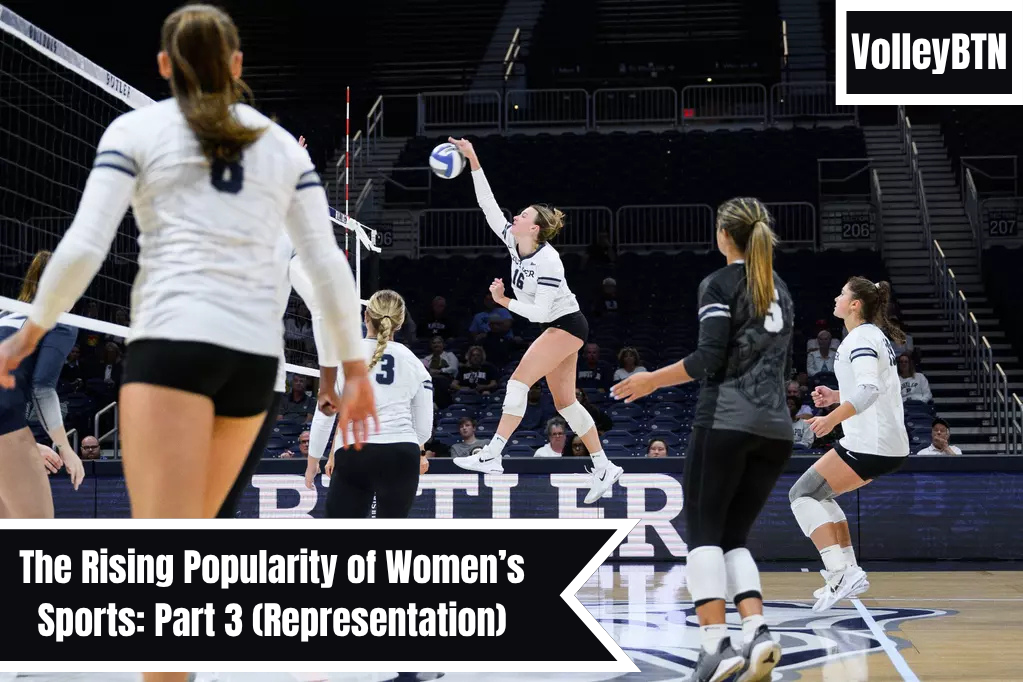
Now that we’ve looked at how female athletes are getting more media coverage, let’s also take a look at how female athletes are being in that coverage!
Historically, when female athletes were covered, their physical appearance, femininity, and/or heterosexuality was prominently displayed. Moreover, the media were way less likely to focus on women’s athletic accomplishments and game play than they were for men.
We know that coverage of female athletes has surged in the past decade (if you haven’t already, take a look at my second post about that here). With my research, I wanted to figure out if that increase in coverage had any impact on the type of coverage athletes were receiving.
As I’m sure most of you know, Coco Gauff just won the French Open, which is especially exciting because she is the first American player in a decade to win (and the youngest in 25 years!). The last American player to win a French Open was, you guessed it, Serena Williams. The image on the left came from a Sports Illustrated article covering Williams’ win back in 2015. The image on the right is also a Sports Illustrated article reporting on Gauff’s win. This is a prime example of how, in the last decade, media outlets have shifted to highlight women expressing their competitiveness and intensity rather than depicting them as always smiling.


Now let’s take a look at what my data said about the changes in type of coverage female athletes receive, and whether that coverage had more of a focus on athletic achievement. I coded more than 600 photographs of female athletes from top stories on ESPN, Sports Illustrated, and the NCAA websites over the past decade, assessing the photographs using multiple metrics. Two metrics in particular allow me to assess whether the increase in coverage we’ve seen over the past decade is also associated with an increased focus on athletic accomplishments: shot type and facial expression.
In examining the data on shot type, over the past decade I found a significant decrease in posed or staged photos, relative to action and game day shots. From 2015-2019, just over 10% of pictures were posed. In contrast, from 2020-2024, less than 3% were from photoshoots. While ESPN and Sports Illustrated started with higher shares of photoshoot style pictures than NCAA, the decline was significant for all three sites.

When examining facial expressions, I found an increase in intense facial expressions vs. smiling or neutral facial expressions. Overall, from 2015-2019 only 40% of the photos had intense facial expressions, with 60% of the photos featuring smiling or neutral expressions. In contrast, there was a 50-50 split from 2020-2024. This increase was statistically significant for ESPN and Sports Illustrated, but not for NCAA, which, on average, already had a higher share of pictures of female athletes with intense facial expressions in the first five years.

Overall, my research this year found that not only has the amount of media of female athletes increased, but female athletes have increasingly been portrayed in ways that highlight their athleticism and talents.
I absolutely loved tackling this project this year, and I am proud of what I discovered, but there is still plenty more research to be done! Hopefully I will get a chance to talk about additional research in future posts.
Data Notes
- Photo Credit: Butler University Athletics
- A more complete discussion of the methodology behind my research is written up here. The project involved coding thousands of top articles from sports media websites, and also more detailed coding of photographs of more than six hundred pictures of female athletes in those articles. More on the general trends in the articles can be found here.
- As with a lot of the data analysis on this website, some of the trends over the past decade in this project were complicated a bit by Covid. NCAA.com sports coverage patterns were more disrupted by Covid than ESPN or SI, not surprisingly.
- There is a lot of academic research out there on how female athletes have been represented in the media, but relatively little on how it has been changing over time. Also a lot of the academic focus has been on analyzing a handful of particular forms of media (such as Sports Illustrated covers) and with a rapidly changing media market and the increased importance of social media, it’s not necessarily clear that findings from research conducted ten or twenty years ago still hold. That being said, my research does suggest that at least in the sports media sites I examined, inequities still exist.