
Earlier today I watched Texas A&M, a 3-seed, upset the undefeated overall number one seed Nebraska in five sets on the road. This is the first time in a decade that the overall top seed has failed to make the national semifinals in the tournament. And in the following match, 3-seed Wisconsin took down one-seed Wisconsin. It’s exciting, competitive, high level volleyball.
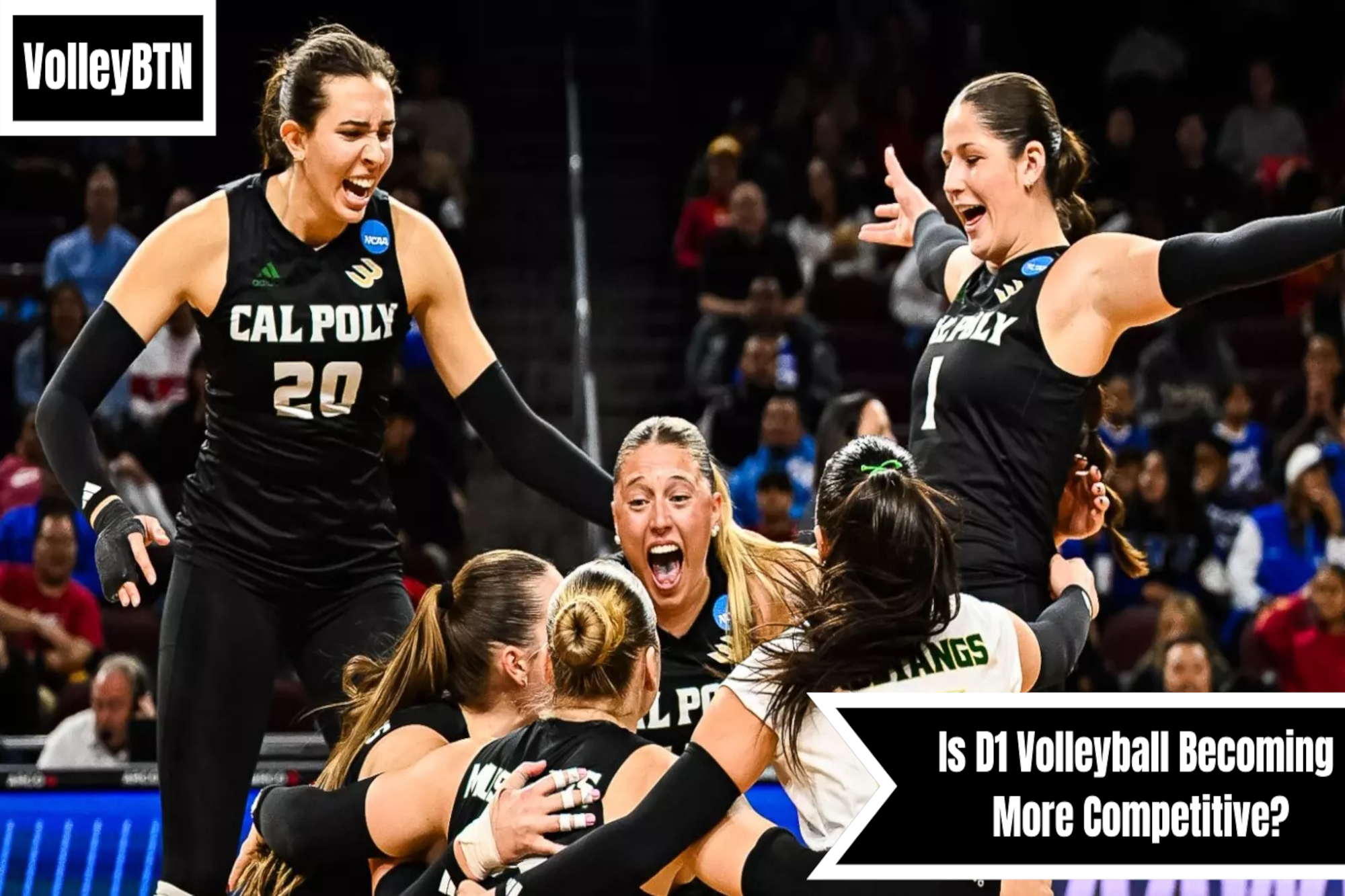
We saw competitive matches and upsets earlier in the tournament, as well. Cal Poly became the first unseeded team to make the Round of 16 since the NCAA started seeding the top 32 teams of the bracket in 2022. In the first round, there were eight five-set matches, which is twice as many as we saw last year. In fact, the total number of first round five-set matches this year nearly matched the total from 2022, 2023 and 2024 combined (9 in total).
Seeing all this made me wonder – is D1 volleyball becoming more competitive overall?
People have been worried about the opposite. People are suggesting that many of the most important recent changes in college sports may lead to the ‘rich getting richer’. NIL opportunities and the House settlement are having a dramatic effect on the recruitment of collegiate athletes and many have worried that schools with more limited resources cannot compete.
On the other hand, at least for volleyball, there may be some trends that push in the opposite direction. The increased pool of athletes starting volleyball at a younger age might be contributing to a deeper pool of elite college volleyball players than in the past. The transfer portal is now drawing large number of athletes into it each year, and if there are elite athletes who are on a team’s bench that are unhappy with their playing time, they may transfer to other teams more readily than in the past, potentially ‘spreading the wealth’. The transfer portal might not always have this effect though, as it also allows players who feel they are underplaced on their current team to try to move up to join (and strengthen) a more competitive team.
All in all, watching the tournament has made me feel that the competitiveness of the sport may be increasing, but is there more systematic data to back up my impression?
One quick way to look at this is to see whether the tournament has become more competitive over time. We can use the Comeback and Competitiveness Ratings I introduced here and here and examine competitiveness in the last five years of the DI tournament calculating the numbers based on play-by-play data from the NCAA.
The 2025 tournament is not yet over, but I have scraped and analyzed the data from the first two rounds of the tournament for every year from 2021 to 2025. The first two rounds represent the substantial majority of games and are probably more representative of the broader range of DI volleyball than the final rounds of the tournament.
The scatterplot below shows the average Comeback and Competitiveness Ratings for Round 1 tournament matches for the past five years. The graph suggests a clear trend toward more competitive matches and bigger comebacks in the first round. Across the past five years we’ve seen a clear year-over-year increase in the average Comeback Rating, increasing overall from just over 55% in 2021 to just over 61% in 2025. And while the increase in Competitiveness Rating hasn’t been on as consistent an upward trend, there has been a sizeable jump in the past two years. 2021-2023 averaged a 3.4, but 2024 was 3.9 and 2025 4.0.

The scatterplot below is for Round 2, and while 2025 is marginally lower than recent years in terms of the average Comeback Rating, once again 2024 and 2025 have the two highest average Competitiveness Ratings. And, consistent with what we should expect (and with the DIII tournament earlier this year), Round 2 is more competitive than Round 1.

Overall, we’re looking at a small number of matches – round one is thirty-two matches, round two is sixteen matches – so the numbers above represent the competitiveness of just 240 matches over the past five years. It will be interesting to dig into the regular season data to see if there is any pattern or trend in the much larger number of matches.
But that’s a task for another day. For now, as a fan I’m enjoying watching competitive, high level volleyball, and I’ll leave the bigger data analysis task for another day.
Data Notes:
- Photo Credit: Cal Poly Athletics
- The largest comeback in the first round this year according to my metric was UNI’s reverse sweep of Utah (95.8%). Utah led by several points late in the 3rd before UNI’s comeback. The most competitive match? Baylor holding off Arkansas State (10.8), a five setter with three sets going to deuce and one to extra points. Nothing in the second round was quite as dramatic.
- The biggest Comeback Rating in a tournament game in the past five years? Penn State’s reverse sweep of Nebraska in last year’s semifinals. Penn State was down to well below a 1% match win probability when they were down 16-22 in the fourth set, but they rallied to win the fourth set and won a tightly contested fifth set.
- The most competitive match of the past five years? The highest Competitiveness Rating was 14.7 (!) for the second-round match between Louisville and UNI last year. Four of the five sets were extremely competitive, with the fifth set only ending at 22-20!